Wood Fired vs Electric Sauna: Running Cost and Chimney
Wood fired vs electric sauna, worked out: $1.14-2.84 of bought firewood vs up to $2.18 of power per session, plus a $1,342-1,670 chimney.
The verdict
For most home saunas: a correctly sized 6-8 kW electric heater. Wood-fired only if the site has no power or the firewood is free.
Bought firewood and grid power cost about the same per session ($1.14-2.84 of red oak at $200-500 a cord vs at most $2.18 of electricity at the US average rate), but a wood stove adds a $1,342-1,670 chimney, insurer disclosure and chimney sweeping. Wood wins where there is no 240V circuit or you cut your own.
We earn a commission if you buy through this link. It never changes the pick.
The Plunge Lab · Updated 2026-10-28 · 9 min read
What one sauna session costs in fuel, wood vs electric
Dollars per session (heat-up plus a 30-minute session)
- Wood, one refuel0.74-1.84
Harvia M3, 5.9 kg of red oak at $200-500 a cord
- Wood, two refuels1.14-2.84
Harvia M3, 9.1 kg of red oak at $200-500 a cord
- Electric 6 kW, ceiling1.32-2.68
9 kWh at Washington to California rates
- Electric 8 kW, ceiling1.76-3.57
12 kWh at Washington to California rates
Electric at the US average rate: 1.63-2.18
Harvia M3 declaration of performance (ignition 2.7 kg, refuel 3.2 kg); Utah State Extension firewood table (red oak 3,528 lb per dry cord); WCAX, October 2026 ($200-500 per cord); Almost Heaven KIP manual (45-60 min heat-up); EIA Electric Power Monthly Table 5.6.A, August 2026 residential rates. Electric bars assume the elements never cycle off.
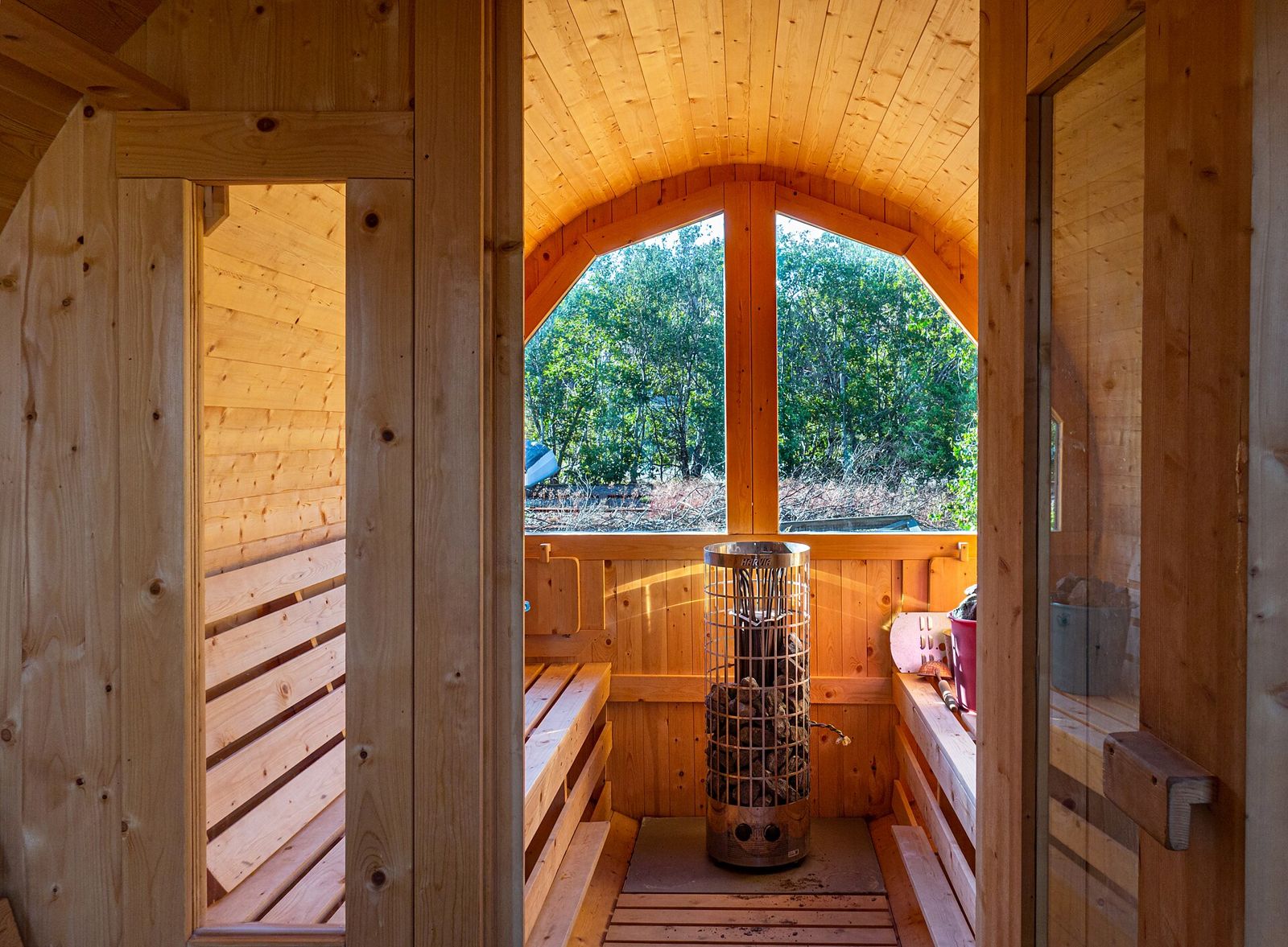

Wood fired vs electric is less a question about the heat than people expect. Almost Heaven, which sells both kinds, says on its wood-burning heater page that "the overall experience is similar whether heating with electric or wood." What separates them is three numbers: what one session costs in fuel, what the chimney costs before the first fire, and whether the sauna site has a 240V circuit at all. All three are worked out below from the heater manuals and current listings. We have not used either kind of heater; this page rests on published specifications.
Should you get a wood fired or electric sauna heater?
- Pick electric if the sauna sits close enough to the house to run a 240V circuit, you want it to start on a timer, and you would be buying firewood anyway. A 6 kW Harvia KIP needs a 30-amp double-pole breaker and 10/2 copper wire; the 8 kW needs 40 amps and 8/2 wire (Almost Heaven's KIP installation manual).
- Pick wood if the site has no power, you have your own seasoned firewood, your sauna's maker approves a wood stove for that model, and you are willing to tend a fire and sweep a chimney. A wood stove needs no electricity at all.
Wood stove vs electric heater: what do the numbers say?
To compare like with like, here are two Harvia heaters sized for the same room. The M3 wood stove is rated for 211-459 cubic feet; the 8 kW KIP electric heater for 250-425 cubic feet.
| Harvia M3 (wood) | Harvia KIP 8 kW (electric) | |
|---|---|---|
| Rated output | 16.5 kW | 8 kW |
| Heater price | $969 without stones, $1,093 with (Sun Valley Saunas) | $1,317 with dial controls (Almost Heaven) |
| Flue | T600-class chimney, 115 mm connection; chimney kit adds $1,487 | None |
| Power at the site | None needed | 240V, 40 A double-pole breaker, 8/2 wire |
| Stated heat-up | 45-90 minutes for wood-fired saunas generally (Sun Home Saunas) | 45-60 minutes to at least 170°F |
| Fuel per session | $1.14-2.84 in bought firewood (worked below) | Up to $2.18 at the US average rate (worked below) |
| Upkeep | Empty the ash box, sweep the chimney | Rearrange or replace stones |
All prices listed, read October 2026. Wood stove specifications from Harvia's M3-series manual; KIP specifications from Almost Heaven's KIP manual and Sun Valley's listing.
Is a wood fired sauna cheaper to run than electric?
Only if the wood is free. With firewood bought by the cord, a session costs about the same as electricity. Here is the working, so you can swap in your own wood price or utility rate.
Electric: kilowatts × hours × your rate
Almost Heaven's KIP manual says the sauna should reach at least 170°F "in 45-60 minutes." Take the slow end, add a 30-minute session, and assume the elements never switch off: 8 kW × 1.5 hours = 12 kWh. A 6 kW heater on the same basis uses 9 kWh. That is a ceiling, not an estimate: the thermostat cuts the elements once the room is hot, and since no manufacturer publishes that duty cycle we will not invent one.
The EIA's Electric Power Monthly (Table 5.6.A) puts the August 2026 US residential average at 18.16 cents per kWh. So 12 kWh × $0.1816 = $2.18, and 9 kWh × $0.1816 = $1.63. Across real state rates from the same table:
| Rate (Aug 2026) | 6 kW, 9 kWh | 8 kW, 12 kWh |
|---|---|---|
| Washington, 14.63¢ | $1.32 | $1.76 |
| US average, 18.16¢ | $1.63 | $2.18 |
| Michigan, 22.99¢ | $2.07 | $2.76 |
| California, 29.75¢ | $2.68 | $3.57 |
Wood: kilograms per fire ÷ pounds per cord × price per cord
Harvia's declaration of performance for the M1/M2/M3 group lists an ignition load of 2.7 kg of wood and a refuelling load of 3.2 kg. The manual adds that "it takes only a couple of pieces of wood to maintain the bathing temperature." Count one ignition load plus two refuels for a heat-up and a session: 2.7 + 3.2 + 3.2 = 9.1 kg, which is 20.1 lb.
A cord is 128 cubic feet of stacked wood, and Utah State University Extension's firewood table gives an air-dried cord of red oak at 3,528 lb. WCAX reported in October 2026 that Vermont buyers "can expect to pay between $200 to $500 per cord."
- At $200 a cord: $200 ÷ 3,528 lb = 5.7¢ per lb. 20.1 lb × $0.0567 = $1.14 a session.
- At $500 a cord: $500 ÷ 3,528 lb = 14.2¢ per lb. 20.1 lb × $0.1417 = $2.84 a session.
- With one refuel instead of two (5.9 kg, 13.0 lb): $0.74-1.84.
- Lighter wood costs more per pound. Birch dries to 2,992 lb a cord in the same table, which moves the two-refuel range to $1.34-3.35.
Wood is not much cheaper because the stove is bigger and loses heat up the flue. The M3 is rated 16.5 kW against the KIP's 8 kW for a similar room, and Harvia declares a total efficiency of 69% for the M3 group. The same USU table gives red oak 24.6 million Btu per dry cord, or about 6,973 Btu per lb. So 20.1 lb holds about 139,900 Btu (41 kWh), and 69% of that is about 28 kWh delivered, more than twice the electric ceiling. If that sounds like more fire than you need, use the one-refuel row. Either way, bought firewood and grid power land in the same $1-3 band, and wood only wins outright when you cut it yourself.
To run the electric side with your own numbers, use the running cost calculator.
Do wood fired saunas need electricity?
No. That is the strongest case for wood. HUUM's Hive Wood manual says the stove "can only be heated with wood logs," and the technical data in Harvia's M3 manual lists no electrical connection at all. Electric heaters, by contrast, need a dedicated 240V circuit sized to the heater. HUUM's Drop manual lists a 30 A breaker and 10 AWG wire for the 4.5 and 6 kW models, 40 A and 8 AWG for the 7.5 kW, and 50 A and 8 AWG for the 9 kW, and says "only a certified electrician is allowed to connect the heater." If the sauna sits at a cabin or a far corner of the land with no service, wood is the only heater on this page that works there.
What clearances and chimney does a wood burning sauna stove need?
This is where wood costs money and space. Every figure below is a minimum distance to combustible material, from each maker's own manual or listing:
| Stove | Room | Above | Sides / rear / front | Listed price |
|---|---|---|---|---|
| Harvia M3, 16.5 kW | 211-459 ft³ | 1,200 mm (47 in) | 250 / 300 / 300 mm | $969 |
| Harvia Pro 20, 24.1 kW | 283-706 ft³ | 1,300 mm (51 in) | 300 / 300 / 300 mm | $1,559 |
| Narvi NC 16 | 282-565 ft³ | 49 in | 6 / 6 / 20 in | $1,695 |
| HUUM Hive Wood 13 kW | 212-459 ft³ | 47.3 in (1,200 mm) | In HUUM's manual (the table does not label which side is which) | $2,150 |
Prices are stove only, without stones or chimney, listed at Sun Valley Saunas, read October 2026.
Three rules apply across Harvia's manual. The chimney must be rated T600. The stove "is not suitable for installation in a shared flue system," so it cannot borrow the house chimney. And the floor matters: a plain concrete floor needs to be at least 60 mm thick, while a wooden floor needs Harvia's protective base. HUUM's manual adds that the stove "should only be connected to the chimney by a specialist."
The chimney is often the biggest line in a wood build. At Sun Valley, adding the chimney kit to an M3 with stones takes it from $1,093 to $2,580, or $1,487 more. HUUM's chimney options for the Hive Wood add $1,342 (through the ceiling), $1,559 (barrel sauna) or $1,670 (through the wall). Almost Heaven's complete M3 Kit, with protective base, surround, 2.5 m of stainless chimney and stones, is listed at $3,939, and its Legend 150 Kit with chimney at $5,308. For barrel builds specifically, see the barrel sauna buying guide.
What is the best electric sauna heater for a home sauna?
"Best" mostly means "correctly sized." Each of these lists its room range, and HUUM warns that its warranty "is not valid, if the output of the heater does not correspond to the calculated volume of the sauna room." Size yours first with the sauna heater size guide.
| Heater | kW / amps | Room | Listed price |
|---|---|---|---|
| Harvia KIP (no control) | 6 kW / 25 A | 170-300 ft³ | $1,010 (Sun Valley) |
| Harvia KIP with dials | 8 kW / 33.3 A | 250-425 ft³ | $1,317 (Almost Heaven) |
| HUUM Drop | 6 kW / 25 A | 180-350 ft³ | $1,506 (Sun Valley, control and stones extra) |
| Harvia The Wall | 6 kW | Small to medium rooms | $1,607 (Almost Heaven) |
| Saunum Air 7 bundle | 6.4 kW / 26.67 A | Up to 282 ft³ | $4,665 (Sun Valley, with control and stones) |
Browse electric sauna heaters on Amazon. Check that any listing states its kW, its voltage and the room volume it is rated for before you buy.
Does a wood stove change your insurance or need a permit?
Plan for both. Insure.com notes that "most insurance companies ask new customers if they have heaters like wood stoves," that "failure to disclose the heater can result in your insurance policy being canceled or a claim denied," and that insurers "may ask to inspect the heater or wood stove to make sure it has the proper clearance and permits." Whether the premium changes "depends on your insurer and the type of heater." Call your insurer before you buy, not after.
On permits, Harvia's manual says "all local regulations... need to be complied with" and points owners to "the local fire authorities in charge of approving the installations." On the electric side, HUUM's manual requires a certified electrician for the connection; ask that electrician what your jurisdiction needs for a new 240V circuit.
Which wood stove setups should you skip?
- A stove price compared against a heater price. A $969 stove with no chimney is not cheaper than a $1,317 electric heater. Compare the chimney-included total.
- A wood stove in a sauna its maker does not approve for one. Almost Heaven says wood-burning heaters are "recommended for certain outdoor sauna models only," and marks the Legend 240 "not recommended for use in our saunas."
- An undersized stove. Harvia warns that "a stove with too low output must be heated longer and more intensely, which will shorten the stove's life span." Its manual also says glass, tile and brick surfaces raise the output you need.
- Wet wood. Harvia: "Dry wood is the best material," and moisture has "a significant impact on how clean the burning is." Utah State adds that green wood "may contain 50% or more water by weight" and makes more creosote.
What does each option cost beyond the heater?
- Wood: the chimney ($1,342-1,670 in the listings above, $1,487 for Harvia's kit at Sun Valley), floor protection on a wooden floor, a dry place to store a cord, and regular sweeping: Harvia says the chimney "should be swept at regular intervals," because unswept soot can ignite.
- Electric: the electrician and the 240V run (get a quote; it depends on distance), stones if not included ($59 for a KIP at Sun Valley), and a smart control if you want phone start (Harvia's Xenio CX170 adds $1,035 to a KIP at Sun Valley).
- Both: ventilation. HUUM says the air "should exchange six times an hour." The whole-build picture is in the outdoor sauna guide.
Wood or electric: the short answer
If you have power at the site and buy your firewood, go electric: a correctly sized 6-8 kW heater is listed at $1,010-1,607 in the table above, needs no chimney, and runs at most $1.63-2.18 a session at the US average rate. Go wood if the site is off-grid or the wood is yours: the stove itself starts at $969, but budget another $1,342-1,670 for the chimney, call your insurer first, and expect to tend the fire.
Frequently asked
- Do wood fired saunas need electricity?
- No. A wood stove heats the room with no power at all; HUUM's Hive Wood manual says it can only be heated with wood logs. An electric heater needs a dedicated 240V circuit, for example a 30 A breaker and 10 AWG wire for a 6 kW HUUM Drop.
- How long does a wood fired sauna take to heat up?
- Sun Home Saunas puts wood-fired saunas at 45 to 90 minutes, longer in winter. For comparison, Almost Heaven's KIP electric heater manual says 45-60 minutes to at least 170°F. Neither is much faster than the other.
- Is a wood burning sauna cheaper to run than electric?
- Only if the wood is free. With red oak at $200-500 a cord, a Harvia M3 heat-up and session (ignition load plus two refuels, 9.1 kg) costs about $1.14-2.84. An 8 kW electric heater running flat out for 90 minutes at the August 2026 US average of 18.16 cents per kWh costs at most $2.18.
- Does an electric sauna need to be vented?
- Yes, for fresh air rather than smoke. HUUM's Drop manual says the sauna air should exchange six times an hour. An electric heater needs no chimney.
- Are wood fired saunas healthy?
- We make no health claims for either heater. The one difference worth knowing is smoke: the EPA says wood smoke is a mixture of gases and fine particles that can cause burning eyes and illnesses such as bronchitis, with children, older adults and people with heart or lung disease at greater risk. Harvia's troubleshooting section treats smoke coming into the sauna as a flue fault, such as poor draught or a leaking flue connection. If you have a heart condition or are pregnant, talk to your doctor before using any sauna.