PlungeChill by the Numbers: The BTU They Don't Publish
PlungeChill is a paid partner held to our spec test anyway: their own cooling rates work out to 1,200-1,700 BTU/hr. That fits 60-80 gallons, not 120.
The verdict
Worth buying at the $499 sale price for a 60-80 gallon tub. Not at the $1,099 list.
At $499 with a pump and filter already built in, it undercuts an assembled DIY 1/4 HP build at $616-870 and removes the pump-matching problem entirely. Their own published cooling rates work out to roughly 1,200-1,700 BTU/hr, which comfortably serves 60-80 gallons and does not support their stated 120 gallon maximum. At $1,099 list, a Penguin at $1,950 delivers far more measured capacity per dollar.
We earn a commission if you buy through this link. It never changes the pick.
The Plunge Lab · Updated 2026-08-26 · 8 min read
The capacity they will not print, derived and placed
BTU/hr: derived capacity against what each tub size actually needs
- A 66 gal tub needs (their own test scenario)990-1,320
At the 15-20 BTU per gallon floor. The derived capacity clears this.
- PlungeChill 1/3 HP, capacity DERIVED1,180-1,720
They publish none. This is a pulldown average, a floor rather than a rating.
- A 120 gal tub needs (their stated maximum)1,800-2,400
The derived capacity does not reach it. The claim is optimistic.
- 1/4 HP class, published and rated2,200-2,300
EcoPlus and Active Aqua, measured and printed
- 1/2 HP class, published and rated4,100-5,750
Active Aqua, Penguin and Penguin HE
Honest fit: a 60-80 gal tub: 900-1,600
Derived from PlungeChill's own published cooling rates: 66 gal (550 lb) from 75°F to 50°F in 8-10 hr is 13,761 BTU, and to 45°F in 12-14 hr is 16,513 BTU. That yields a pulldown AVERAGE, which includes ambient gain and falling capacity as water cools, so it is a real-world floor and not comparable like-for-like with the rated figures shown for the 1/4 and 1/2 HP classes. Tub requirements use the 15-20 BTU per gallon floor from our sizing guide. Disclosure: PlungeChill is a paid affiliate partner.
Disclosure first, because it changes how you should read everything below: The Plunge Lab is a paid affiliate partner of PlungeChill. We earn a commission if you buy through our link. That relationship is exactly why this page applies the same test we apply to everyone else rather than a softer one, and why the verdict below is conditional instead of enthusiastic.
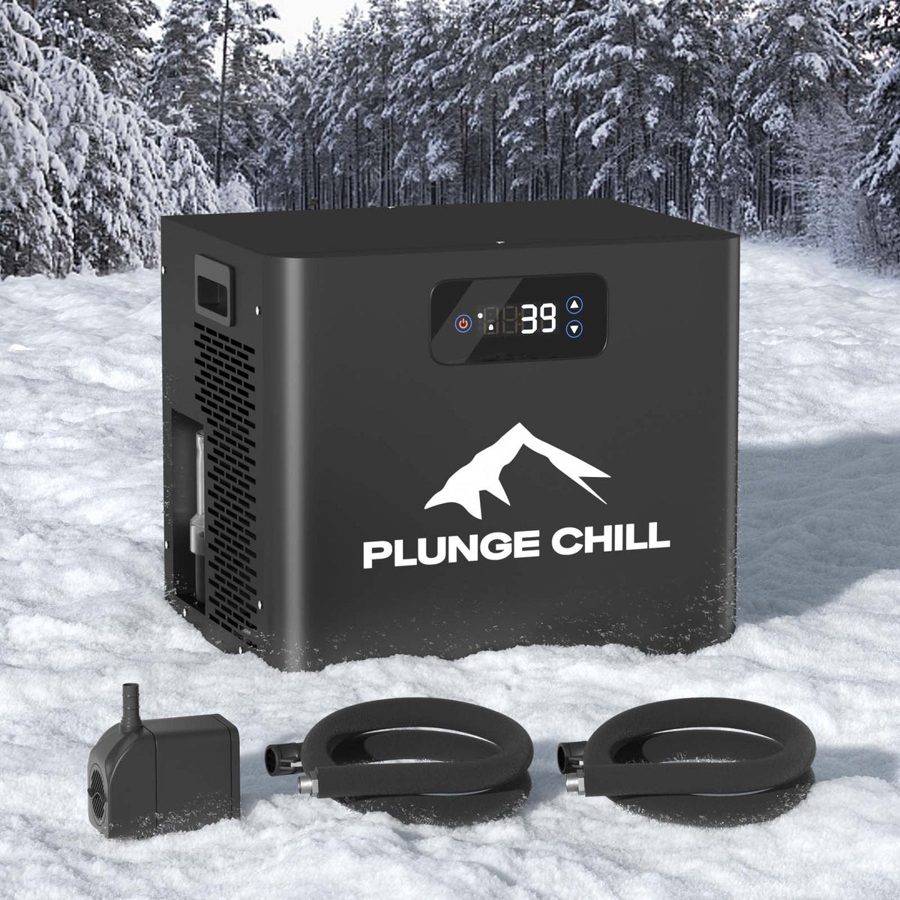
The headline problem: PlungeChill does not publish a BTU/hr figure for its chillers. Not on the product page, not in their own horsepower guide, which offers industry generalities in place of their own number. We have called that disqualifying on a $200 no-name listing and on Ice Barrel's $3,999.99 unit. It does not stop being disqualifying because we now earn on the link.
What they publish, and what they do not
| Specification | Published? | Value |
|---|---|---|
| Cooling capacity (BTU/hr) | No | Stated nowhere; their own guide cites market averages instead |
| Amps / volts | No | Not stated |
| Refrigerant | No | Not stated |
| Compressor | Yes | 1/3 HP, 600W |
| Cooling rates | Yes | 66 gal: 75°F to 50°F in 8-10 hr; to 45°F in 12-14 hr |
| Minimum temperature | Yes | 39°F |
| Noise | Yes | 39-45 dB |
| Recommended volume | Yes | Up to 120 gallons |
| Warranty | Yes | 2-year usability guarantee |
Deriving the number they will not print
Their published cooling rates are enough to recover an approximate capacity, which is the whole point of doing arithmetic in public. On their own 66 gallon scenario:
- 66 gal times 8.34 lb = 550 lb of water.
- 75°F down to 50°F is a 25°F drop: 550 times 25 = 13,761 BTU removed. Over their stated 8-10 hours, that is 1,376-1,720 BTU/hr.
- 75°F down to 45°F is 30°F: 16,513 BTU over 12-14 hours, or 1,180-1,376 BTU/hr.
Call it 1,200-1,700 BTU/hr effective. One caveat has to travel with that number wherever it goes, including into any comparison you make yourself: this is an average across a pulldown, including ambient heat leaking back in and the unit losing capacity as the water gets colder. It is a real-world floor, not a rated capacity, and it must not be set beside the rated 2,200-2,300 BTU/hr of the 1/4 HP class as though the two were measured the same way. The honest comparison is that a rated figure would likely be somewhat higher than this derived one, and we cannot say how much because they will not tell us.
The 120 gallon claim does not survive the arithmetic
PlungeChill recommends this unit for tubs up to 120 gallons. Against the 15-20 BTU per gallon floor from our sizing guide, 120 gallons needs 1,800-2,400 BTU/hr. The derived 1,200-1,700 does not reach it, and even a generous rated figure would be working hard at the top of that range in a warm room.
Run it the other way and the honest fit falls out: at 1,200-1,700 BTU/hr, the 15-20 BTU per gallon floor supports roughly 60-80 gallons. That is not a small tub. It covers a compact barrel, most single-person setups, and their own 66 gallon test scenario comfortably. It is simply not 120. Size to 80 gallons and this chiller is well matched; size to their maximum and you are buying the complaint.
Where it genuinely beats the alternatives
- The pump is built in. This is the real story and it is easy to miss. Aquarium-class chillers are bare heat exchangers, so a working 1/4 HP build costs $616-870 once you add a correctly-sized pump and fittings, as the DIY teardown works through. At $499 with a pump and mesh filter integrated, PlungeChill undercuts the assembled DIY route and removes the GPH-matching mistake that ruins those builds.
- A 2-year guarantee against a 1-year industry standard. Penguin and Hydrofarm both warrant one year. Doubling that on the component most likely to fail is a genuine, checkable advantage, and one of the few places a brand here is ahead of the field on paper.
- 39-45 dB published. The quietest published figure we have found in this category, against Penguin's 56 dBA and 59 dBA. If your plunge shares a wall with a bedroom, that gap matters more than a few hundred BTU, as the apartment guide argues.
What it still does not do
- The mesh filter is not water care. They describe it as trapping leaves, sand and debris, which is coarse-strainer duty. It is not 20-micron sediment filtration and there is no ozone or UV. You still need the stack in the filter setup guide, about $100-140, or you will be draining weekly regardless of what the chiller does.
- No published electrical detail. 600W is stated; amps are not. That matters if you are checking whether it can share a circuit.
- No refrigerant disclosed. Relevant to long-term serviceability, and the sort of thing the brands with full spec tables simply print.
The price is the whole verdict
At $499, this is a good buy for a 60-80 gallon tub, particularly in a noise-sensitive space, and particularly for someone who does not want to source a pump. At $1,099 list, the calculus inverts: a Penguin at $1,950 publishes 5,000-7,500 BTU/hr with a pump and quick-connects, which is far more measured capacity per dollar, and you are no longer paying a discount to accept an undisclosed spec. Check which price is live before you decide, because this product appears to move between the two.
The bottom line
PlungeChill sells a genuinely useful thing at the sale price and asks you to trust them on the one number that defines the product. We are not willing to do that, so we derived it: roughly 1,200-1,700 BTU/hr effective, which fits a 60-80 gallon tub and not the 120 they claim. Bought at $499 for a correctly-sized tub, with the pump included, the 2-year guarantee and the quietest published noise figure in the category, it earns a recommendation. Bought at list, for a big tub, on the strength of the marketing, it does not. We would rather tell you that while earning a commission than pretend the missing spec is not missing.
Check the current PlungeChill price
Prefer to compare against the aquarium-class alternatives first? 1/4 HP chillers with published spec tables are the units this one is competing with.
Frequently asked
- How many BTU is the PlungeChill chiller?
- They do not publish a BTU/hr figure. Deriving it from their own published cooling rates (66 gallons from 75°F to 50°F in 8-10 hours) gives roughly 1,200-1,700 BTU/hr effective. That is an average across a pulldown rather than a rated capacity, so a rated figure would likely be somewhat higher, but they do not state one.
- Is the PlungeChill chiller big enough for a 120 gallon tub?
- The arithmetic says no. At the 15-20 BTU per gallon sizing floor, 120 gallons needs 1,800-2,400 BTU/hr, and the derived capacity is 1,200-1,700. Running it the other way, 1,200-1,700 BTU/hr supports about 60-80 gallons. Their 120 gallon recommendation is optimistic; size to 80 and the unit is well matched.
- Is PlungeChill worth the money?
- At the $499 sale price, yes for a 60-80 gallon tub: it includes a pump and filter, so it undercuts an assembled DIY 1/4 HP build at $616-870 while removing the pump-sizing problem. At the $1,099 list price it is harder to justify, since a Penguin at $1,950 publishes 5,000-7,500 BTU/hr with the pump included.
- Is the PlungeChill filter enough on its own?
- No. Their built-in filter is described as trapping leaves, sand and debris, which is coarse-strainer duty rather than 20-micron sediment filtration, and there is no ozone or UV. You still need a proper water-care stack (roughly $100-140) or you will be draining weekly.
- How loud is the PlungeChill chiller?
- They publish 39-45 dB, which is the quietest published figure we have found in this category. For comparison, Penguin publishes 56 dBA for its 1/2 HP and 59 dBA for its 1 HP. In an apartment or against a bedroom wall, that difference is likely to matter more to you day to day than a few hundred BTU.